The Nixon Administration and the Middle East Peace Process, 1969-1973 by Boaz Vanetik Zaki Shalom
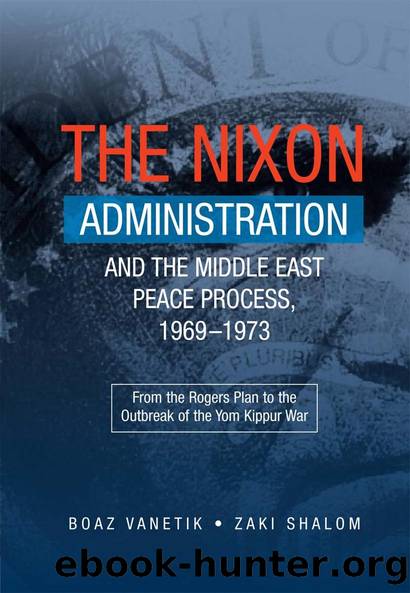
Author:Boaz Vanetik, Zaki Shalom [Boaz Vanetik, Zaki Shalom]
Language: eng
Format: epub
Tags: History, Middle East, Israel & Palestine, General, United States, 20th Century, 21st Century
ISBN: 9781845197209
Google: AzPnrQEACAAJ
Publisher: Sussex Academic Press
Published: 2015-05-15T03:36:38+00:00
CHAPTER 10
Ongoing Efforts to Reach an Interim Israeli-Egyptian Agreement
Rogersâs Middle East Visit: May 1971
On 4 May 1971, Rogers and his team arrived in Egypt. In the two days of discussions the Americans held with Sadat, they talked about ways to promote the partial agreement in the Canal, as well as what the role of the US should be in mediating between Israel and Egypt. The talks proceeded in a good atmosphere, and Rogers even praised the Egyptian position as it was expressed in Sadatâs initiative of February 1971 and his reply to the Jarring memorandum. On 5 May 1971, Egypt presented Rogers with an official memorandum summarizing its current positions on the matter of the interim agreement for reopening the Canal.
In the memorandum, Egypt stated that the Israeli withdrawal from the Sinai and the Gaza Strip would be carried out in two stages, and announced that it would accept demilitarization in the Sinai, so long as it was implemented equally on both sides of the border. Heikal notes that the Egyptian memorandum also stated that the withdrawal arrangements were to be supervised by a UN force, whose representatives would be headquartered in Sharm El-Sheikh and Gaza. Egypt also announced that if Israel were to accept its proposal, it would agree to extend the ceasefire by six months, but stressed that if Israel refused to fulfill its obligations on the matter of the withdrawal, the Egyptian government would reserve the right to liberate its territory by force.1
The Soviet presence in Egypt was of great concern to Nixon. The president and Rogers sought ways to reduce the Soviet influence in Egypt. They calculated that a breakthrough in the Middle East diplomatic process could greatly diminish the Soviet influence in the region, especially in Egypt. Several days prior to his ten-day mission to the region, Nixon and Rogers discussed the importance of reducing the Soviet presence in Egypt. The president and the Secretary of State felt that a breakthrough in the diplomatic process would greatly reduce the influence the USSR had in the region, since the Soviet hold was based, first and foremost, on Arab dependence on Soviet arms. With the declassification of new materials from the American National Archives, including recordings of President Nixon, it can be seen that in two discussions between Nixon and Rogers, the Secretary of State informed the president that Sadat had offered to expel the Soviet advisers from Egypt in return for promoting the diplomatic process with Israel and returning Egyptian territory:
âI know whatâs uppermost in your mind and I want to talk about it at once [ ⦠]and thatâs the Soviet Union,â Rogers quoted Sadat as telling him. âI donât like the fact that we have to depend on the Soviet Union as much as we do. I am a nationalist. I want to remain a nationalist [ ⦠]. I donât want to have to depend on anyone else. The only reason I have is because we were [Egypt] humiliated [in the Six Day War] and I had no place to turn [apart from the Soviet Union].
Download
This site does not store any files on its server. We only index and link to content provided by other sites. Please contact the content providers to delete copyright contents if any and email us, we'll remove relevant links or contents immediately.
| Anthropology | Archaeology |
| Philosophy | Politics & Government |
| Social Sciences | Sociology |
| Women's Studies |
The Secret History by Donna Tartt(19088)
The Social Justice Warrior Handbook by Lisa De Pasquale(12190)
Thirteen Reasons Why by Jay Asher(8910)
This Is How You Lose Her by Junot Diaz(6887)
Weapons of Math Destruction by Cathy O'Neil(6280)
Zero to One by Peter Thiel(5802)
Beartown by Fredrik Backman(5754)
The Myth of the Strong Leader by Archie Brown(5508)
The Fire Next Time by James Baldwin(5446)
How Democracies Die by Steven Levitsky & Daniel Ziblatt(5219)
Promise Me, Dad by Joe Biden(5153)
Stone's Rules by Roger Stone(5088)
A Higher Loyalty: Truth, Lies, and Leadership by James Comey(4964)
100 Deadly Skills by Clint Emerson(4925)
Rise and Kill First by Ronen Bergman(4789)
Secrecy World by Jake Bernstein(4753)
The David Icke Guide to the Global Conspiracy (and how to end it) by David Icke(4720)
The Farm by Tom Rob Smith(4513)
The Doomsday Machine by Daniel Ellsberg(4490)
